
If the Money Supply increases faster than real output then, inflation will occur.
If you print more money, the amount of goods doesn’t change. However, if you print money, households will have more cash and more money to spend on goods. If there is more money chasing the same amount of goods, firms will just put up prices.
Theory of Money
formula MV=PY. Where
- M= Money supply,
- V= Velocity of circulation (how many times money changes hands)
- P= Price level
- Y= National Income (T = number of transactions)
If we assume V and Y are constant in short-term, then increasing money supply will lead to increase in price level.

example to explain why printing money causes inflation
- Suppose the economy produces 1,000 units of output.
- Suppose the money supply (number of notes and coins) = $10,000
- This means that the average price of the output produced will be $10 (10,000/1000)
Suppose then that the government print an extra $5,000 notes creating a total money supply of $15,000; but, the output of the economy stays at 1,000 units. Effectively, people have more cash, but, the number of goods is the same. Because people have more cash, they are willing to spend more to buy the goods in the economy.
Ceteris paribus, the price of the 1,000 units will increase to $15 (15,000/1000). The price has increased, but, the quantity of output stays the same. People are not better off, and the value of money has decreased; e.g. A $10 note buys fewer goods than previously.

Therefore, if the money supply is increased, but, the output stays the same, everything will just become more expensive. The increase in national income will be purely monetary (nominal)
If output increased by 5%. and the money supply increases by 7%. Then inflation will be roughly 2%.
Assumptions in the above example
[In the real world, it is possible, if the government printed money, people would just decide to save the extra money and therefore, prices wouldn’t automatically rise. However, to simplify the link between the money supply and inflation, let us assume that consumers are willing to spend the extra money. Also, if you expect inflation to rise, you have an incentive to spend it – rather than see the value of your money fall.]
Printing money and devaluation
If a country prints money and causes inflation, then, ceteris paribus, the currency will devalue against other currencies.
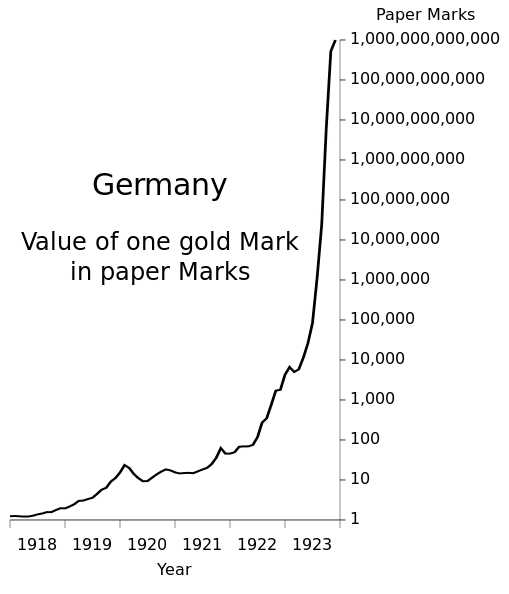
For example, the hyperinflation in Germany of 1922-23, caused the German D-Mark to devalue against the currencies who didn’t have inflation.
The reason is that with the German currency buying fewer goods, you need more German D-Marks to buy the same quantity of US goods.

Examples of inflation caused by excess supply of money
US Confederacy 1861-64. During the Civil War, the Confederacy printed more paper money. In May 1861, they printed $20 million notes. By the end of 1864, the amount of notes printed had increased to $1 billion. It caused an inflation rate of 700% by April 1864. By the end of the Civil War, the inflation rate was hitting over 5,000% as people lost confidence in the currency.[“Inflation in US confederacy:. Encyclopedia.com]
Germany 1922-23. In 1921 one dollar was worth 90 Marks. By November 1923, the US dollar was worth 4,210,500,000,000 German marks – reflecting the hyperinflation and loss in value of the German currency.
Link between money supply and inflation in the real world

The above analysis is something of a simplification. For example, in the real world it is hard to measure the money supply (there are many different measures from M0 narrow money to M4 wide money) Also, in a liquidity trap (recession, different printing money may not cause inflation.
However, this provides a rough explanation why printing money usually reduces the value of money causing prices to increase thoughts on “Why Printing Money Causes Inflation”
